
Issue 4 Note From The Editors
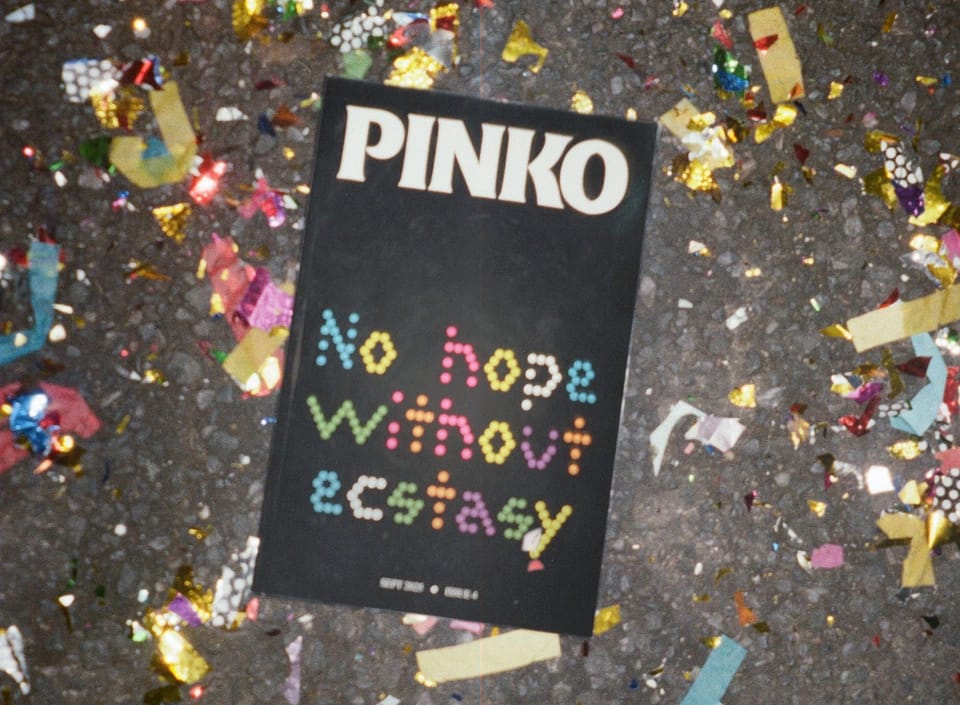
“We write from a time of war,” we proclaimed in the editors’ note to our last print issue, where we reaffirmed resistance to the Zionist campaigns of annihilation in Gaza and condemned the United States’s acts of fascist terror on trans people.
So, what time is it now?
If, when we began preparing for the previous issue, the mood was foreboding, the mood for this issue has been harder to pin down, though the situation feels ever more imperiled. This may be because the war has escalated further than ever. We began work for this issue before Trump was elected and continued assembling it as he assumed office. Conditions changed. Kidnappings of neighbors, workers, and students are increasingly common. Trans life, while always under scrutiny, has become the target of the federal state—its ultimate goal: eradication. Some of the texts in this issue, then, speak to us from across a gulf, though others remind us that the perils that feel like an emergency have long been in preparation. Alongside an expansion of martial fronts, open rebellion has also broken out in proletarian neighborhoods and workplaces, leaping from spontaneous resistance against worksite raids onto the wide streets of Los Angeles and the farmlands of the Californian coast. We see masses fighting off the armed men who patrol the borders of working-class life, leaving a smoldering pyre of robotic taxis in their wake. Are these still-burning embers of the fires which evicted the Third Precinct in Minneapolis now half a decade ago? Of the 2024 mobilizations for Gaza? Much remains to be revealed, but the rebirth of summer revolt is a sign that the class still struggles wherever it finds itself.
The flaming cop car has accompanied our project as something like a mascot since our inception in 2019. It first appeared to us as a historical marker, a high point of past struggle that we wished to preserve for future resurrection. In 2020, exhilaratingly, it erupted in the present, forcing a cruel lesson in the limits of the real movement’s actual capacity to confront the state. Does the image still hold promise for the future now that we have seen it from both sides? Can we detect it somewhere through the smoke in LA?
Pinko has always had a historicizing impulse. We wish to bring the legacy of past struggles into contact with the present and to record the transforming present as material for future understanding. Our historical repertoire may have allowed us to track the now regnant disaster as it came into being, but the reward for prescience is cold comfort. The wager of retrieving these traditions and holding them up to the light was that some strategic lessons might emerge, if not a program, then at least a negative example. Some of that wager has cashed out, but the primary reverberation has been to restore a dimension of kinship with prior generations of fighting queers and revolutionary sex deviants, not as heroic ancestors but as recognizable peers with familiar limits and gifts, who struggled like us to create lives which could survive an onslaught and which imperfectly did.
Three of these predecessors we honor in an expanded in memoriam section: Amber Hollibaugh (1946-2023), Cei Bell (1955-2024), and Cecilia Gentili (1972-2024), all women whose efforts to wrest space for themselves from the world left room for others to follow in their wake. Julia Harris reflects on the intimate and local details of Philadelphian Cei Bell’s life as they informed the work of the group Radical Queen, co-founded by Bell and Tommi Avicolli Mecca in 1973. Cecilia Gentili’s publisher, LittlePuss Press, shares a recording of Gentili discussing childhood family photos, which we transcribe and feature in these pages. Of her grandmother’s garden, lush with tangerine trees, flowers, and plants, Gentili said: “this was the place where I was the happiest as a child.” And Lisa Duggan discusses Amber Hollibaugh’s life, writing, and activism, responding to an archival recording of Hollibaugh’s speech after the Dan White trial verdict in 1979—the night of the White Night riots in San Francisco, which we reprint here too. That night, Hollibaugh’s words ignited both the crowd and squad cars—in flames and in revolt.
A proponent of the necessary entanglement of sexuality and politics, Hollibaugh notably argued that “there is no human hope without the promise of ecstasy.” Corey Devon Arthur, writing from Otisville Correctional Facility in New York State, considers sexuality inside and outside the prison walls. The wide, fleshy, porous and intellectual realm of sex for Arthur here includes the routine state-sanctioned sexual violence of the strip-frisk, Audre Lorde’s uses of the erotic, sex work, drug deals, and orgies. In Pinko editor Sol Brager’s “Anatomy of Gay Riot,” a graphic collage returns to images from a scene of filmmaker Arthur Bressan Jr.’s Forbidden Letters, shot in 1979 on Alcatraz island, interspersed with local journalism and community propaganda following the White Night riots, evoking something of the heat of that moment. Bresson had previously visited Alcatraz as part of a documentary team in support of the occupation of the prison island by a group calling themselves Indians of All Tribes, but returned for his second narrative feature in the wake of the Briggs Initiative fight and the murder of Harvey Milk, which ties the closet to the prison. This dynamic, where pursuing supposedly identitarian concerns in fact opens up onto class war, is given treatment in theoretical form by Bruno Monfort Miro, who argues for a reading of the “Pervasiveness of Identity” in the shadow of the defeat of the classical worker’s movement.
In this grim situation, we still sought some promise of ecstasy, a vitality and exuberance that could carry us through struggle. We found some in SiegedSec, the trans furry hacker collective that achieved online infamy in 2023. A (possible) leader of SiegedSec chats with Pinko editor Lou Cornum about the convergence of trans furries and hacker communities and the motivations, objectives, and outlook of the politically indeterminate group who we can, at the least, say are committed to trans people’s right to troll in public.
The relation of transness to the public is broached in a wide-ranging conversation between theorists Sophie Lewis and Emma Heaney, who draw on two of their recent books to theorize cisness as a comprehensive Marxist feminist analytic of patriarchy. Heaney reminds us to pay attention to “the activities that never attain the dignity of movement work; every time a queer or trans person or a woman splits a dose of hormones, offers another a couch, a shoulder, a meal, or care around an abortion, a birth, a surgical procedure, every time people in community care for each other within and beyond the bounds of legal or biological family.”
In our last issue, we included an editorial reflecting on the growing momentum around a movement calling explicitly for trans eradication from the public. Now that this movement has effectively gained complete power of the US state, it seems to be looking where Heaney does too, in its attempt to crush the social basis for the expansion of trans existence in the last decade, scrutinizing newly elaborated relations of medical, bureaucratic, and legal care. This is accomplished through new limits to the Affordable Care Act; legal proscription of any sort of recognition; return to punishment for recognition (risk of abuse charges, loss of licensing, etc.); the criminalization of youth medical transition; the retrenchment of borders and a bureaucratic warfare that includes the denial of passports, visas and other federal identity documents; detention for immigration status without any protection on basis of gender status; the elimination of HIV prevention; the dismissal of civil rights cases challenging banned books on race, gender and sexuality in schools; state enforcements barring trans girls and women in women’s sports; and on and on. This unruly litany of manufactured abandonment remains unfinished, but it speaks to the sheer devastation of what we are up against.
All the death-dealing brutality of these fascist logics, which were already present before the rise of this administration’s far-right populism, cannot be overcome by queer sociality alone. The terms of a necessary escalation needed to destroy capitalism are then only hinted at in this issue—far more evident is the simple necessity for serious study and dialogue among gay communists across generations. As well as international solidarity across continents. In this issue, we also include two interviews with queer people surviving the genocide in Gaza, one a gay man living with HIV in northern Gaza, and the other a trans woman living in a school, displaced from her home and family. They are primarily concerned for their survival. But they speak from within “the only place in the world that is fully communal,” right now, in the writer Salma Shawa’s words. There is no liberatory horizon in genocide, needless to say, when the sky in Gaza itself is a vector of Israeli annihilation. But an encounter with the actual experience of people who refuse to accept the death sentence the world has ratified for them may also help remind us of the astonishing capacity for resistance, and all the complexities and difficulties that resistance encounters.
It is against this scene—and from the imperial core, from where we write and where we must stake our claims—that we offer this editor’s note. The time is still here, yet fraying. Ecological and social collapse accelerate under capitalism’s intensifying cycles of creation and destruction in a world fast exhausting its margins. Some days, the order of things feels on the verge of breaking while elsewhere the world has already ended—yet the true break we long for has not arrived. So we no longer ask, as we once did, what time it is. We demand to know: what time will it be—if we make it ourselves?